
The Digital Finds Project
The Digital Finds Project was designed to provide a digital catalogue of Anglo-Saxon finds from the excavations at West Stow. The aim was to update that information into a digital form so that it is accessible online to anyone who might be interested. Universities, schools, archaeologists and individuals from all over the world have studied West Stow and we hope to make that easier for them and for future generations.
94 examples available on Flickr photo sharing
94 examples, plus other photos, available on Pinterest photo sharing
Background
The West Stow finds originated from several sources – antiquarian collecting in the 19th century when the cemetery was explored, the Prof. Vera Evison excavations (1957-61) and the Stanley West excavations (1965-1972). The objects were held in Bury St Edmunds at Moyse’s Hall Museum and Suffolk Archaeology Unit with certain objects at the British Museum and several other museums. In 1999 they were reunited to form the displays and stored archive in the new Anglo-Saxon Museum at West Stow. At that time they were also joined by other material from local Anglo-Saxon sites and cemeteries such as Westgarth Gardens, Eriswell (Lakenheath) and Mildenhall.
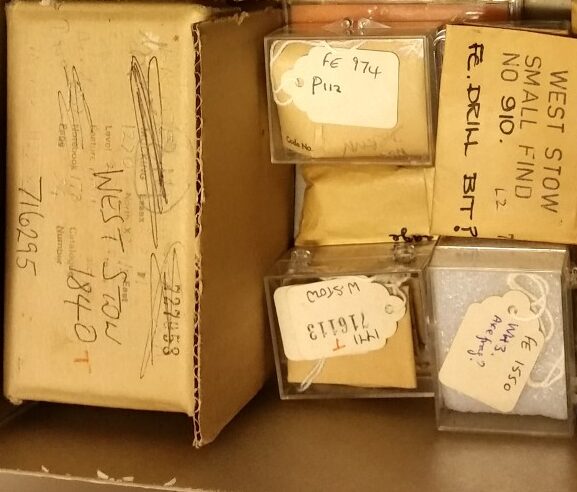
Image: some examples of the storage of small finds as they were excavated
During the various excavations, the finds were packed in paper envelopes or cardboard boxes
The problem with these is that hold acids which when released can damage the objects
In 2002 the documentation of the Anglo-Saxon collections was started by the then Manager (Alan Baxter) and Suffolk Association for Museums volunteer Dr. Alan Lower. Dr Stanley West (Archaeological Consultant to the West Stow Anglo-Saxon Village Trust) provided lots of invaluable advice and support. As well as rationalising the store and archive, Alan Lower documented the small finds collection by hand for three years until 2005. This work has proved invaluable to the Digital Finds Project.
In 2004 Dr. Stanley West retired and in the subsequent years he organised the transfer of all his slides, photographs, plans, notebooks and Ancient Monument Lab documents to West Stow to complete the invaluable archive of the material he excavated at the original location.
In November 2015 Friends of West Stow volunteers started work, co-ordinated by qualified museum professional (Alan Baxter), now no longer a member of staff but a Friends member and Heritage Consultant. Originally there were a total of five volunteers on the project, but this reduced over time to just the last two volunteers, Elaine and Alan.
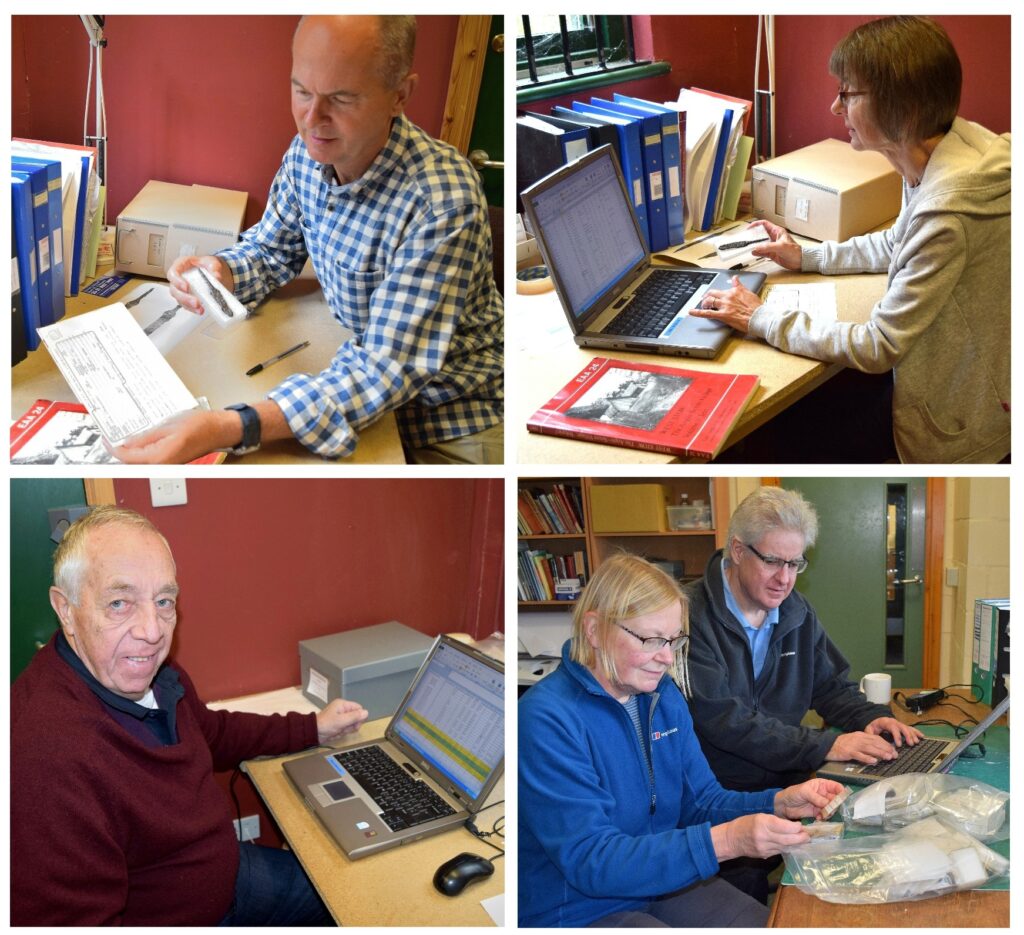
Image: ( clockwise) Alan Baxter, Elaine Pitt, Maritta Matthias with Shaun Cooley, and Rodney Cox.
Originally there were five volunteers in 2015
The volunteers required training and supervision from a museum professional. That professional also needed to be available to help make decisions during the cataloguing process. There were errors in the original records which needed to be resolved
The volunteers attended on different days to suit their schedules. For various reasons, the 5 volunteers reduced over time to just the last two volunteers, Elaine and Alan. Work finished in 2020
Work on the small finds finished in 2020, mainly due to Covid, but with the following achievements:
- 1,954 Small Finds catalogued
- 2,324 Volunteer hours logged
- 612 Ancient Monument Lab photos catalogued
- 68 New plastic storage boxes created and labelled
Cataloguing the small finds
The elements of the Anglo-Saxon archive:
- Archaeological small finds – around 2,500
- Ancient Monument Lab material – lab cards, lab photos(taken before cleaning), x-rays, lists
- Dr West’s excavation photos, slides, film, plans, documents and notebooks
- The various volumes of the East Anglian Archaeology are an essential part of this archive – especially EAA24 West Stow, The Anglo-Saxon Village, 2 volumes; EAA48 West Stow, Prehistoric and Romano- British Occupations.
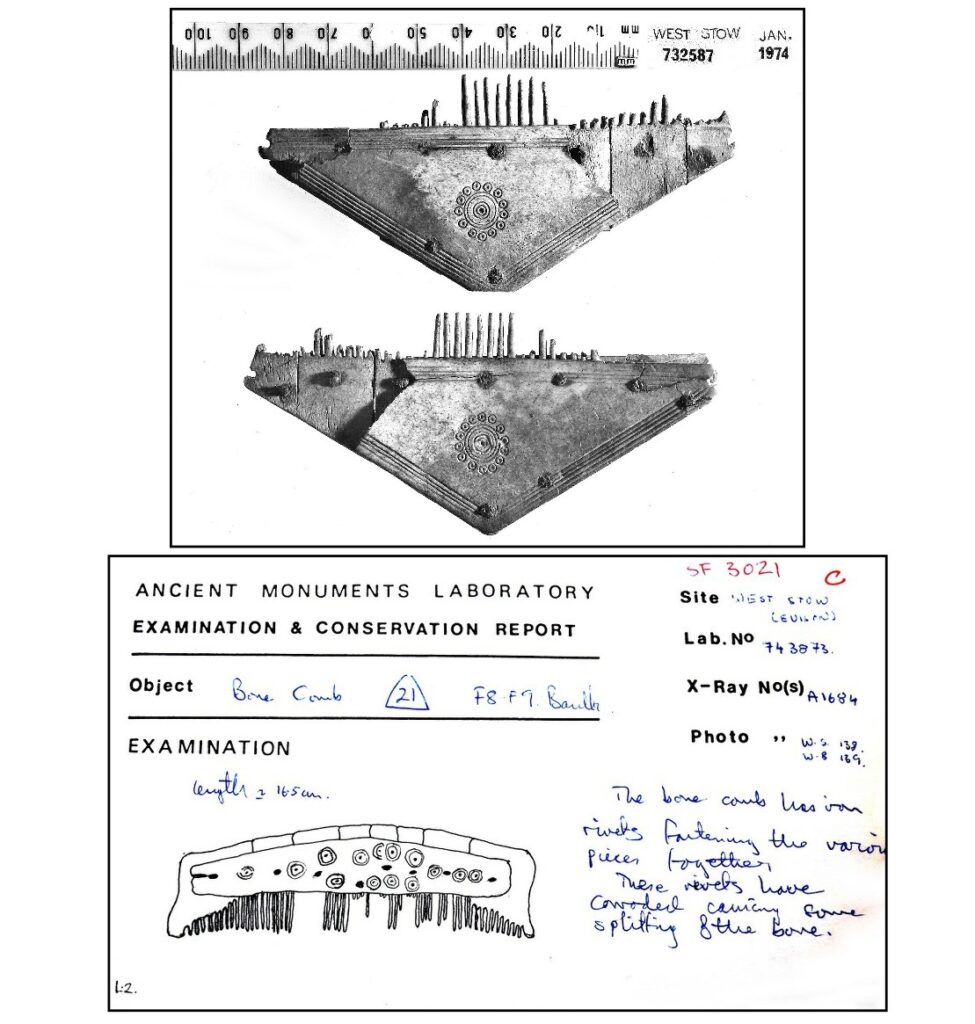
Image: Lab photo of a comb with Lab card of a different comb
Ancient Monument Labs material in the Anglo-Saxon archive
There were two main types of material from the Labs – lab photos (taken before cleaning) and lab cards.
The Lab cards often had drawings of the small find plus valuable information and comments.
In addition, there were also x-rays and other documents about the materials and conservation of the small finds.
The first stage in cataloguing is that the following elements are gathered to complete a spreadsheet which co-ordinates all the known information for each entry. The spreadsheet can then be used to transfer to a MODES record for each object:
- Small Find Number
- AML lab number- exists? Record
- AML lab card – exists? Photograph as required
- AML lab photo – exists? Scan
- Object name, material, brief description from EAA
- Site number (WSW002), context, co-ordinates
- EAA text reference, figure reference
- Object complete, dimensions, condition, marked
- New photo with scale – record and number
- Location – storage or display
Repacking
Once the information on each item is gathered and entered on the spreadsheet, the next stage is to process and repack in the following way:
- Plastic boxes with inert packing used instead of cardboard and paper
- Fragments and very small objects are numbered and stored in plastic bags
- Larger objects are stored in cut-outs so that they are visible inside the clear plastic box
- Old tags, paper bags and boxes stored
- Mark object with its small find number if appropriate
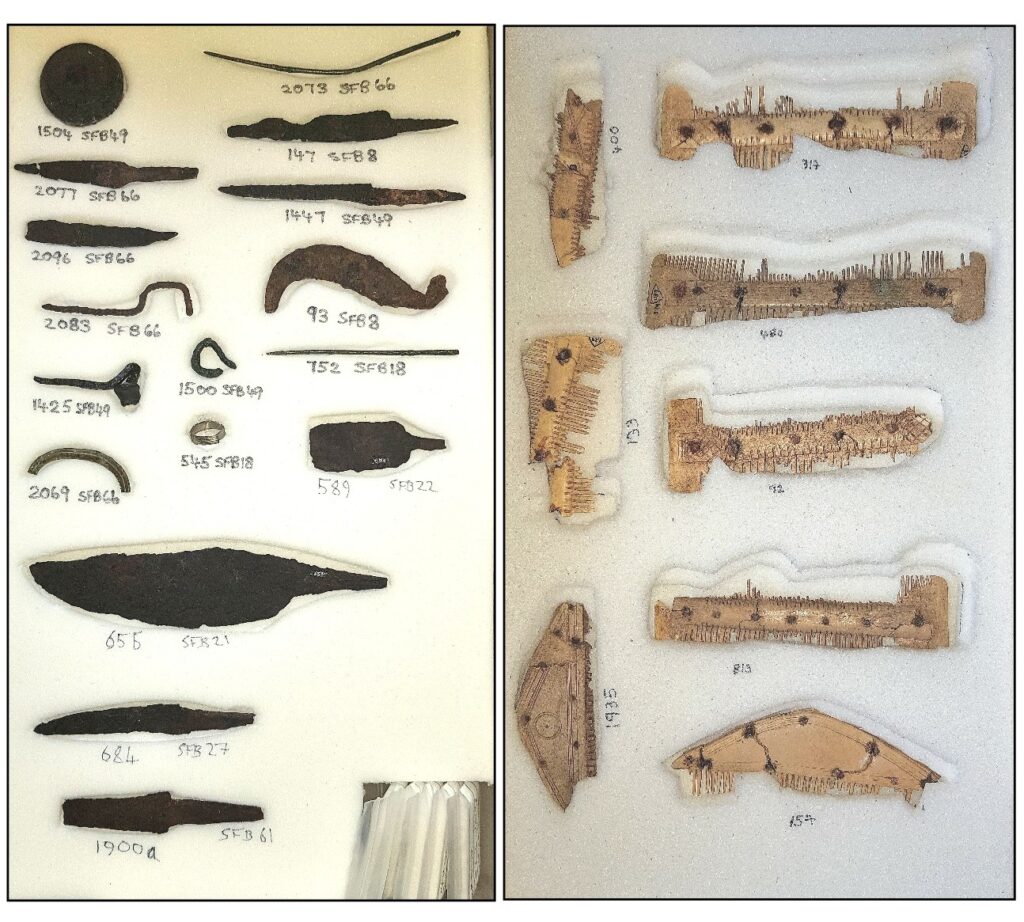
Image: Two different boxes of repacked finds – one with metalwork, one with combs. They have their small find number marked
Repacking the small finds
The small finds were now put into inert foam packaging inside plastic boxes which were well sealed. Each small find had a cut out position so that gaps could be easily noticed.
Previously, all the small finds stored in one box would be ‘rummaged’ through to find a particular item. Now the box has a clear lid and may not even need to be opened to find an object. If close inspection is required then other objects should not be unduly disturbed.
The Modes record
The MODES record can be completed from the spreadsheet. In addition, box numbers and exact location details (i.e. bay and shelf number in the store) can also be added at this point. We are currently examining the practicalities around volunteers accessing the Council’s computer system.
The MODES catalogue at West Stow is not accessible online so we are still looking at options for a sustainable digital platform that is cost effective.
In the meantime, 94 sample photographs, lab photos, lab cards and x-rays are available on Flickr photo sharing and Pinterest photo sharing both of which are free platforms.
Significance
This project has been successful to date because of the co-operation between staff and volunteers. It has a number of significant outcomes, including:
- The first digital catalogue of West Stow small finds
- The first access to small finds details on the internet
- The first photographic catalogue of small finds before and after cleaning
- The first repacking of small finds to improve collections care in 50 years
- The first accurate location system for small finds
- The new clear storage boxes will result in less disturbance of the collection by researchers
- The new storage system saves a lot of space in the store compared to the old
- A greatly enhanced ability to interpret the site through the original finds, using photos, cards and handling boxes
- Cost effective as carried out by volunteers from The Friends working with staff
- The Digital Finds Project team volunteers had the opportunity to work with the wonderful early Anglo-Saxon original objects which were found here and the fascinating original documentation from the 1965 -1972 excavations.
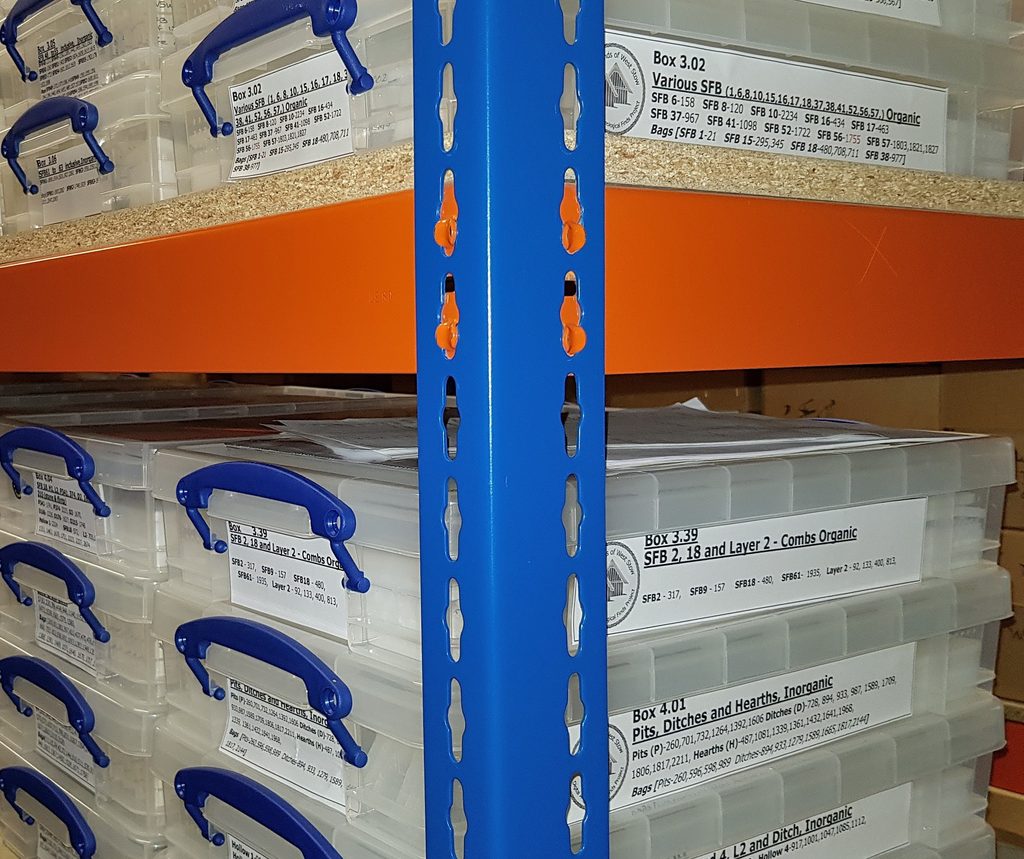
Image: A view of some of the completed boxes in the Archaeology store
A successful small finds project
The small finds have now been catalogued and photographed and form part of the West Stow archive
The digital information is now far more accessible on various platforms, but a sustainable and cost effective platform which encourages access is yet to be found.
These repacked and relabelled boxes of small finds are now stored at West Stow in a much better way than previously and part of the legacy of this important site for the future.