
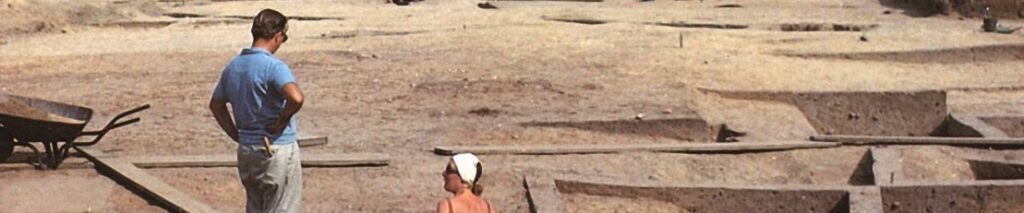
Dr Stanley E. West (1931-2024)
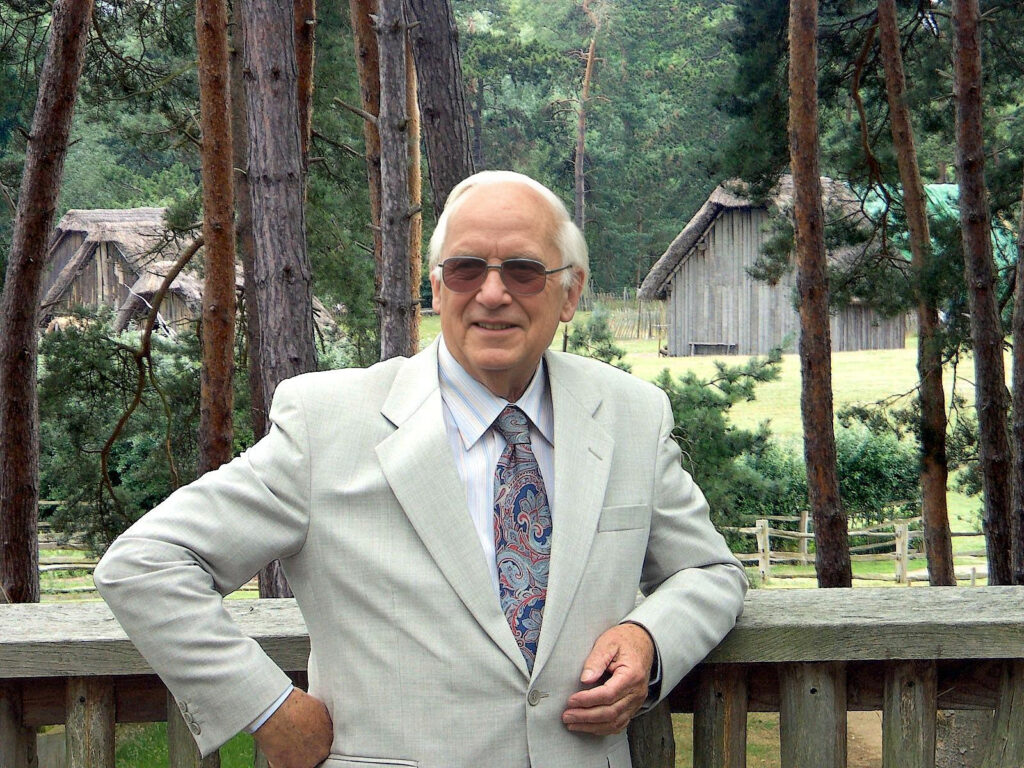
Image: Stanley West at his leaving event as Archaeological Consultant to the Trust in 2004
A very special man
It is impossible to overestimate the impact of this very special man upon the story of archaeology in Suffolk. More than that, he was responsible for so much that has been developed at West Stow Anglo-Saxon Village since his important excavations between 1965—1972.
He was very much involved in the planning and preparation of The Friends of West Stow Anglo-Saxon Settlement and gave a talk at their inaugural meeting in 1980.
The sad news of the death of Stanley West was received in early March 2024, he was 93 years old.
Stanley believed that the outputs of archaeology should be shared with the public as much as practicable. He thought that it was the public who would be key in sustaining sites like West Stow through family visits, school visits and events.
Dr Stanley West was of course instrumental in the concept of starting reconstruction work at West Stow in 1973 and was closely involved with every experimental reconstruction built by Alan Armer and his team of constructors.
He worked closely with staff and the St Edmundsbury Council (now West Suffolk) to develop the first Visitor Centre on the site in 1988 and the National Lottery funded museum and café in 1998. He was Archaeological Consultant to the West Stow Anglo-Saxon Village Trust until his retirement in 2004.
He moved to Gloucestershire to be near his family but his passion for the site at West Stow never faded.
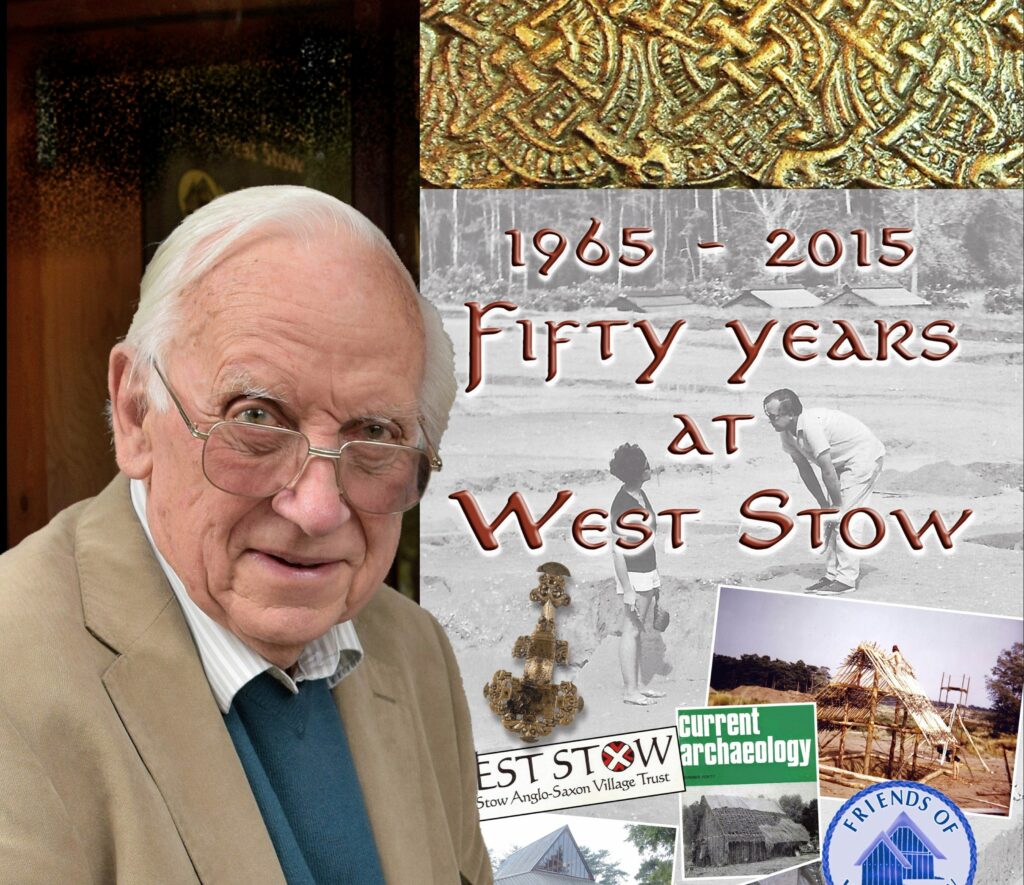
Image: Stanley West at his ‘Fifty Years Celebration’ at West Stow in 2015
50 years celebration
In 2015 he returned to celebrate 50 years since 1965
A host of people gathered to wish him well – archaeologists, members of the environmental archaeology group, staff and members of The Friends of West Stow.
Stanley West had made an important name for himself in archaeology over those years and was first to use the term ‘Sunken Featured Building’- or SFB in shorthand – to describe these early Anglo-Saxon buildings with pits beneath the floors.
We celebrate all he gave to us and owe him a huge debt of gratitude. There follows extracts from ‘A Life in Archaeology’ (S.E.West 2015)
“I was eight years old when Basil Brown opened Mound 1 at Sutton Hoo. Five years later he began to play a major role in developing my interest in archaeology. Not before time, Basil has now been recognised for his great contribution to archaeology in general and to Anglo-Saxon studies in particular. Here I wish to record that it was his boundless enthusiasm, in spite of the bitterness he felt over his treatment at Sutton Hoo, that was to
fuel my interests for over ten years and which had a profound effect on my later career.”
“My first excavation, with Basil at West Stow in 1948, was that of the two Roman pottery kilns which he had discovered some four years earlier. The Anglo-Saxon settlement was evident from surface finds, but not pursued at that time. By 1965 it was evident that the techniques of excavating totally by hand in 15ft squares, as employed by Miss Evison, would not be viable in the face of the mounting threat from the Bury St Edmunds rubbish tip, and that the ultimate objective had to be the complete excavation of the five-acre site, with the overlying sand being removed by JCB, and scraping off the surviving ancient top-soil using the long handled shovels I brought back from Denmark.”
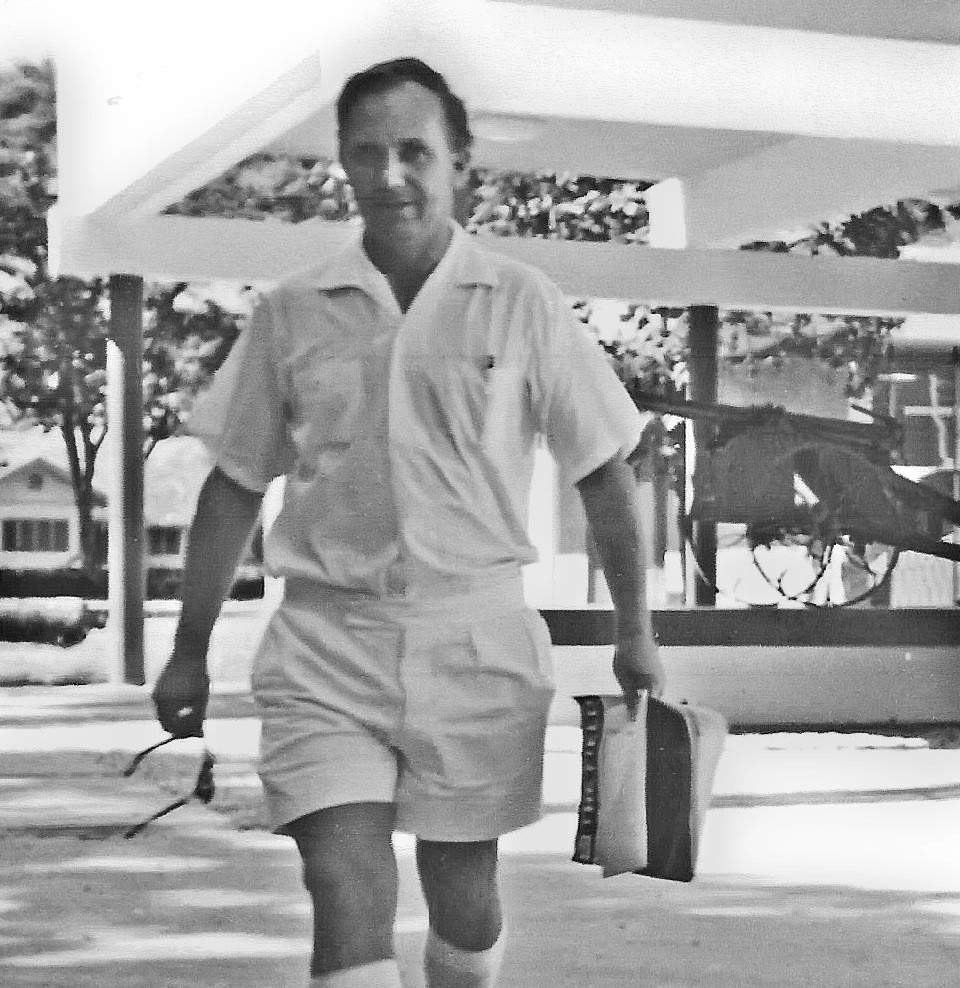
Image: Stanley West at Dar Es Salaam Museum in 1965
A Life in Archaeology
Stanley West in his own words! He wrote ‘A Life in Archaeology’, (Proceedings of the Suffolk Institute of Archaeology, 43 (3), 2015)
“It is with some alarm that I realise that I provide a link which bridges a great divide in archaeology: between the personalities and practice of the first half of the twentieth century and the onset of the great changes that have taken place since the 1960s.
My life in archaeology began at the age of twelve to thirteen years when, inspired by the programme ‘How Things Began’ on the wireless, I moved from fossil-hunting in the red crag to flint implements and began to haunt the Ipswich Museum.”
“All features were to be completely excavated and all material retained, including all the animal bones, against the advice (again) of the Ministry of Works, which was to ‘identify and keep a selection’. That collection was later the subject of a major study by Professor Pam Crabtree and remains the most comprehensive source of environmental material for the early Anglo- Saxons. The excavation closed in 1972 after eight three-month sessions, just as the great revolution in archaeology began with the use of the plastic bag and even computers!”
“The West Stow excavations had been concluded in 1972. Every year the Bury Town Council paid a visit (as light relief, I suspect) and finally demanded to know how to preserve the site. Such was their interest that I proposed that we reconstruct a house to test my new interpretation of Saxon architecture (thinking that the mention of money might end the discussion). Such was the enthusiastic response from the assembled
councillors that the West Stow Anglo-Saxon Village Trust was established, largely by the efforts of John Knight, to whom we all owe a considerable debt. I little realised the extent of the commitment. A timely approach by a dedicated group from Cambridge (later the West Stow Environmental Archaeology Group) enabled the first house to be erected in 1974 to my specifications, with an ongoing programme employing a developed approach from the simplest to the more likely use of the technology available to the Anglo-Saxons.”
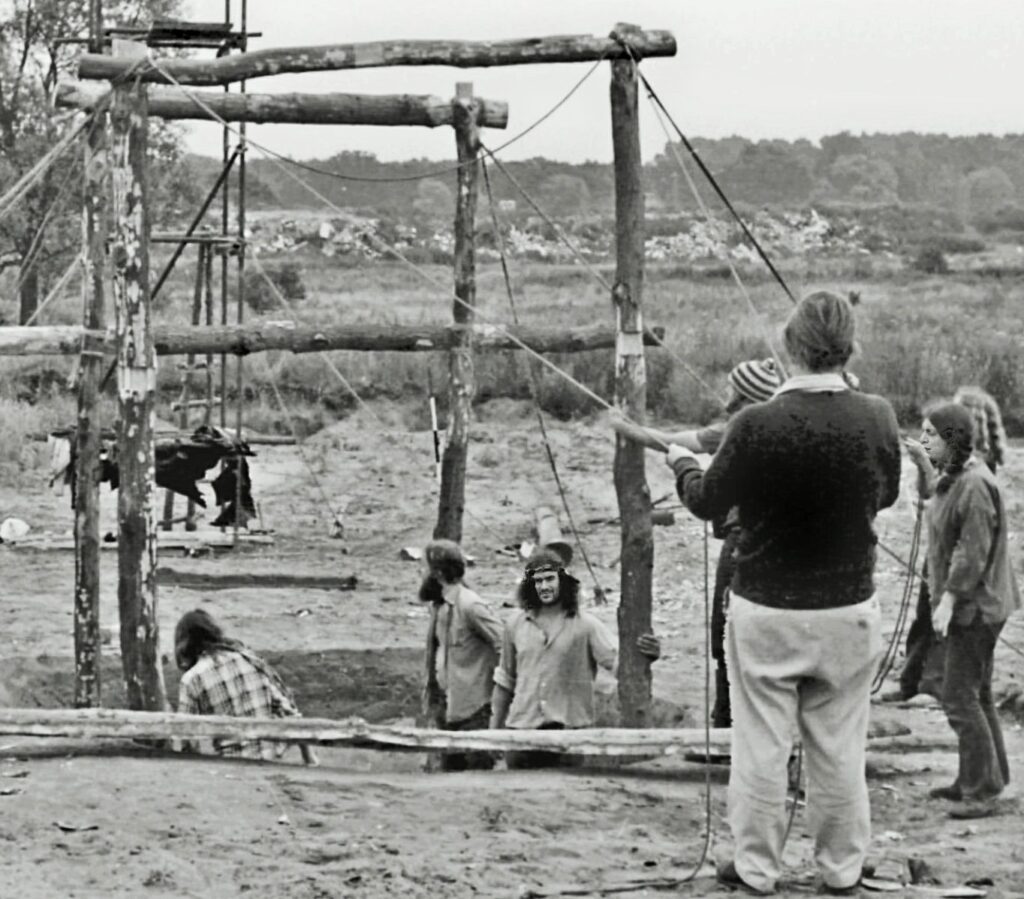
Image: Stanley West working with the Environmental Archaeology Group on what was to become ‘The Oldest House’
West Stow Environmental Archaeology Group
In 1973 there was a group of Cambridge students who had an idea about building an Anglo-Saxon house for their use.
Stanley West, excavator of West Stow Anglo-Saxon Village, was
working on how to present his new ideas about what the houses may have looked like.
These two ideas combined and the West Stow Environmental
Archaeology group began to build an experimentally reconstructed six post ‘sunken featured building’.
This building stood up for over 50 years and for obvious reasons was called ‘The Oldest House’. It was dismantled in September 2024.
It is certainly unusual for an archaeologist to put his interpretations to the test, but then, all those years ago I believed that archaeologists should learn how things were done in the past. I am relieved to say that the buildings still stand; the oldest for over forty years, in spite of the fact that the posts have rotted away below ground.
I retired in 1991. The interwoven strands of my archaeological life track the development of my hopes and some of the plotting and planning that preceded the formation of the Suffolk Archaeological Unit. This then, is my personal celebration of the impact that that most remarkable man, Basil Brown, had on me and ultimately on the archaeology of the region”
But surely it was Stanley who was an equally ‘remarkable man’ who developed and updated practical archaeology, alongside developing the role of archaeology with local government at District, County and Regional levels. There is no doubt that he achieved his own ‘ impact on the archaeology of the region’. Indirectly, he has changed the lives of the over 1 million people who have visited West Stow Anglo-Saxon Village, it is a ‘special place’ – that is what Stow means in Anglo-Saxon. But Stanley’s courageous Experimental Archaeology work there has completely revised our views of these ‘First English’ with archaeologists. Moreover, it has had an effect on all English – we who live in Angle-land – because these new ideas have filtered down to schools teaching what he called ‘this formative period of our history’.
For Stanley’s leaving event in 2004, Dr Sam Newton (a well-known Beowulf scholar) composed a poem in Anglo-Saxon and English for Stanley. The whole poem is on display in the West Stow museum. Some of the lines from this poem seem particularly relevant as we remember him:
“Softly he spoke his sooth-fast wisdom, Mildest of men, but mighty of mind.
Fare thee well, worthy son of West, Suffolk’s friend, wise in winters”.
