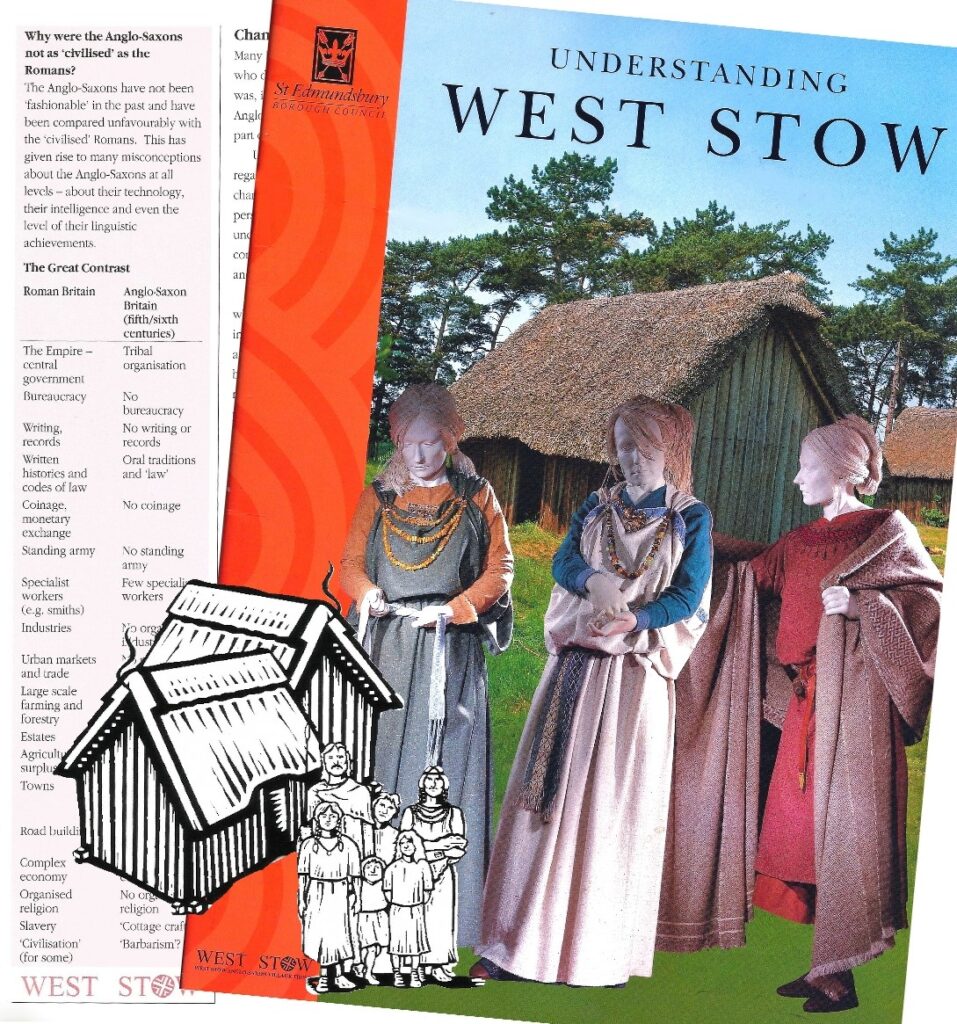
Image: Printed version of Understanding West Stow from 1999
Understanding West Stow
Published in 1999, this informative A4 booklet was written by Stanley West to coincide with the opening of Anglo-Saxon Centre in July 1999.
The Centre was funded by the district council (then called St Edmundsbury Borough Council) and the National Heritage Lottery Fund. The whole project was regarded as a far sighted commitment to our heritage.
In the introduction, he states: “West Stow is the best-understood example of a typical early Anglo-Saxon village and has much to teach us about the society, beliefs and everyday lives of our distant ancestors.

Dr Stanley West explains the discovery, excavation and interpretation of the Anglo-Saxon Village site (from Understanding West Stow).
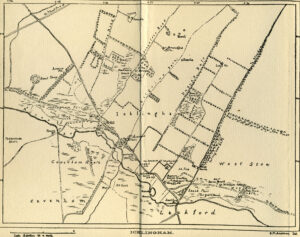
In 1847 men working to raise gravel for use as ballast in barges on the then-navigable River Lark discovered skeletons and numerous urns at West Stow. Between 1849 and 1852 a number of local ‘antiquarians’, as they were then called, made collections of Anglo-Saxon objects from this cemetery (see map below left). Parts of these collections, made by John Gwilt of Icklingham, the Reverend Banks of Dillingham, Cambridgeshire and the Reverend Benyon of Culford, have survived and are to be found in the British Museum at London, the Ashmolean at Oxford, the Museum of Archaeology at Cambridge, and Thetford Museum. Others were held until recently in Moyse’s Hall at Bury St Edmunds and have now been moved to the Anglo-Saxon Museum built here to house the discoveries made on the site.
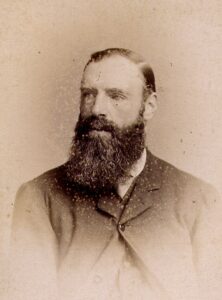
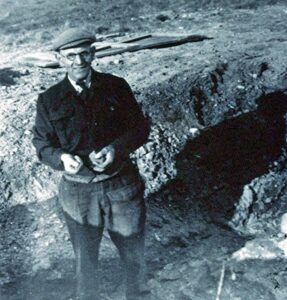
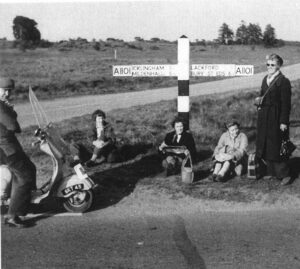
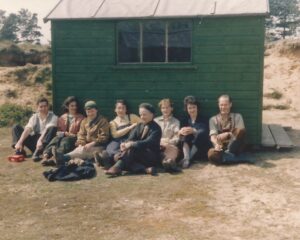
From 1878 to the 1890s, Henry Prigg of Icklingham (above centre) excavated Roman pottery kilns on the heath and found Anglo-Saxon urns etc.’ on the site, although the presence of a village here was still unsuspected. In 1940 Basil Brown, the excavator of the royal ship at Sutton Hoo, excavated two Roman pottery kilns on the site, and in 1947(above right) continued excavating there with the author. Professor Evison excavated here from 1957 to 1961 – see photographs below.
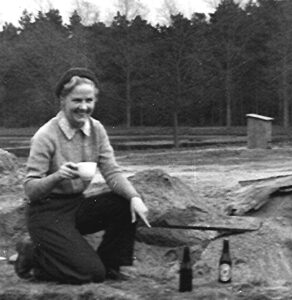
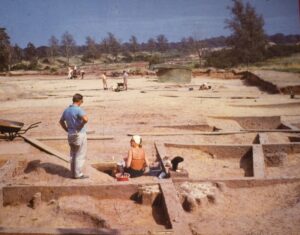
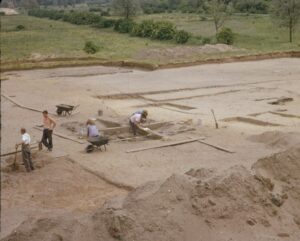
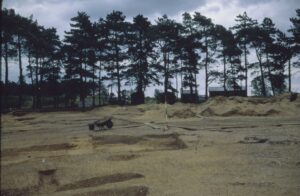
The major part of the settlement was explored from 1965 to 1972 by Stanley West and his team (see photographs below). Thereafter Bury St Edmunds Council, along with Dr West, has promoted and supported this unique project to reconstruct part of the Anglo-Saxon village.
The archaeological evidence was well preserved under a great mound of blown sand deposited here during the medieval period. The non-acidic nature of the soil preserved many pieces of evidence not normally found, including thousands of animal bones, iron and bronze objects, and even seeds and grain, all of which have extended our knowledge of the life of the villagers.
All the buildings were of wood. In a few rare cases houses had been burnt, so that the types of timber used could be identified from the charcoal. Elsewhere house sites could be identified from post holes in the ground, which remained long after the posts themselves had decayed.
The site had been occupied by a succession of peoples since the end of the last ice age. It was used by stone-age hunter-gatherer groups around seven thousand years ago, who left behind flint tools and flakes of stone that were chipped off in making them in eleven concentrations on that hill. Altogether some 21,000 flint flakes and tools were found scattered over the site.
No evidence of domestic Neolithic settlement was found, apart from a scatter of flint tools, including many arrowheads. At the west end of the hill there had been a circular Neolithic burial mound surrounded by a broad ditch. The mound had been much damaged by later activity and long since eroded away. In the centre of the mound area was a large pit with traces of a crouched burial with a single stone bead. The mound acted as a focal point for later Neolithic cremations, which were buried in the ditch fill and the southern edges of the mound area.
Centuries later the hill was occupied by an iron-age settlement, consisting of a number of circular huts, storage or rubbish pits, ditched enclosures for stock, and small field plots. Two larger ditch systems, which had been recut many times, crossed the site from east to west and may have been a modest defence, or some form of boundary’. This settlement, which stood from the third century BC to AD 60, probably represented the growth of a successful farmstead rather than a community and was part of the widespread occupation of the bottom of the Lark Valley which took place at this time.
Reordering and a new administration may have led to the abandonment of the farm before the setting up of a pottery industry here about AD 70. At least ten pottery kilns have been found at West Stow, five of them in a tight group on the hill, together with two small rectangular buildings and eighty-four pits. Great quantities of waste pottery from these kilns were found, which shows that the pottery industry continued for some seventy’ years, producing in the early years a great variety of very fine wares, ranging from white flagons to black bowls, some decorated with distinctive stamps and inscribed lines. Some vessels were stamped with the maker’s sign. There is some evidence that the products were distributed well beyond the immediate area, as name stamps have been found at Colchester and as far away as Doncaster.
The site seems to have lain abandoned again, being used only perhaps for grazing, from the mid-second century until the coming of the Anglo-Saxon settlers in the fifth century. Two miles (3km) away, at Icklingham, an important, large and apparently undefended settlement continued to be occupied until the very last years of Roman Britain.
The early Anglo-Saxon village occupied the site for some 200 years, from about AD 450 to 650, before moving away, over a generation or so, to a new position about a mile (2km) to the east.
The site then remained unoccupied, to be ploughed in the early medieval period before being covered by blown sand in the later thirteenth century.
In 1974, the local Borough Council formed the West Stow Anglo-Saxon Village Trust to reconstruct part of the site and bring the village back to life through reconstructions and displays. Today, the West Stow Anglo-Saxon Village Trust still continues its work in partnership with what is now called West Suffolk Council.